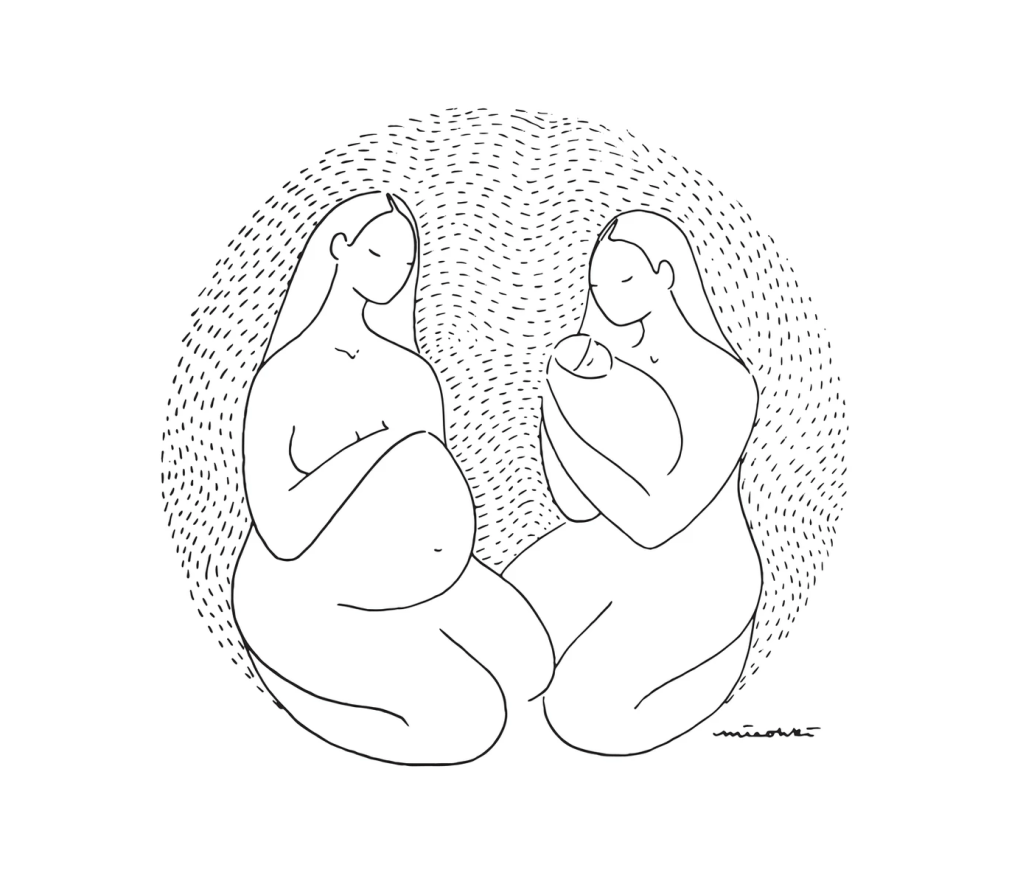
It was Thursday, I had contractions the whole day but they became stronger before going to bed. I had in mind the 5-1-1 rule for contractions (contractions are five minutes apart lasting one minute for at least an hour) and so I downloaded an app to track them. I told my husband we wait it out for at least two hours before calling the hospital and so we tried going to sleep. Even though I was in a drowsy state, I kept my phone in my hands recording the contractions on the app. They were very consistent and slowly getting stronger. After two hours of waiting it out, I woke my husband. At this point, I couldn’t talk as much when I had contractions and so we headed out for the hospital by midnight.
During the first trimester, I began thinking of how I wanted to give birth. I knew I had a lot of time ahead of me, but for this particular journey, I wanted to be completely prepared and confident with my decisions. I first had to change my perception about birth and labour since all I had known were the horror birth stories everyone spoke about. Ina May’s book, Guide to Childbirth was the only book about birth I read during pregnancy and it really changed my perspective on it. With the many positive birth stories of women giving birth naturally, the book opened my eyes to a whole other reality I had not known about.
I came to understand the strength of a woman’s body, especially during birth. Her body is capable of birthing her children naturally. The body knows what it’s going. Her body is built to birth. God created a woman’s body with the ability to birth another human life. She is created in perfection. This in itself is a blessing because women are honoured with this gift from God, the gift of life.
My journey truly began when my perception of birth changed. I decided to give birth naturally with minimal medical interventions. I knew I was capable of it. I knew my body was built for it. I was confident and excited to give birth. During this time, few women around me recounted their birth stories, which were filled with pain, trauma and complications. Upon listening to these stories, I still remained positive about my own upcoming birth even though these accounts could easily become draining. I truly believe one of the main reason for my attitude towards birth was birth education. I studied, I learned and I gained information about everything surrounding childbirth. I equipped myself with knowledge and felt very confident on this journey.
When I arrived at the hospital, I was five centimetres dilated. This was my first ever cervical check, which was extremely uncomfortable and painful. I refused all types of vaginal exams during my prenatal appointments even when my doctor insisted in the last few weeks. I read about the risks and benefits of cervical checks and preferred not to get this type of examination during my pregnancy. I’m glad I refused it, however the first time I was checked for dilation at the hospital, I felt a burning sensation and pain. This feeling continued whenever my cervix was examined during labour. The nurse told me my cervix was paper thin when I was first admitted, which was a good sign since it meant the cervix was preparing for the baby to descend. However, as I kept being examined onwards, my cervix became swollen thus lengthening my labour.
After being admitted, my husband and I were directed to a private room, which was dimly lit and slightly cold. My contractions were slowly getting stronger and closer to each other. Yet I was still able to talk a little and slowly move around. Though, this didn’t last very long before I spent the rest of my labour sitting on the hospital bed. I knew I had to walk around the room and sit in different positions to help the baby descend and to cope with the pain. From the start of my labour at home up until my stay at the hospital, I bled heavily. The nurse told me I was bleeding more than normal and so having lost so much blood early on, I became very weak thus not being able to engage with my baby as I wanted to.
During my pregnancy, I prepared myself for this moment, but when that time came, I felt a bit frustrated with myself for not applying what I learned about labour, like remaining active. Even though I wasn’t able to engage with my baby due to the heavy bleeding, I redirected my energy to handle the contractions. My cousin suggested I use a comb to put pressure on my palm to distract the pain of labour. Instead of using it this way, I brushed the comb bristle’s with my thumb and focused on the sound it produced. This helped me tremendously in redirecting the pain because the sound in some ways camouflaged the pain I was experiencing.
After several hours of being in labour, I remained 5cm dilated. When the doctor arrived, she performed an artificial rupture of the membrane (breaking my waters) to move along the labour. I can’t remember how it felt when she broke it, but after a few minutes, I felt a gush of water pouring down. It felt as though I was peeing and couldn’t hold it in. After my water was broken, soon enough I dilated to 7cm with contractions becoming more intense. I felt my stomach tighten as if all the muscles inside me were squeezing my baby out of my body. When this would happen, a sharp pain travelled across my back, which I found unbearable. Whenever this pain would arise, I called my husband who would rub my lower back bringing some form of relief. The familiar touch and knowing someone was there for me were reassuring.
According to the doctor, I wasn’t progressing fast enough and she informed me how my baby’s face was facing upwards instead of downwards. She suggested I take the epidural even though I knew I was capable of continuing without it. I asked for an hour before making the decision and finally decided to take it considering the position of my baby.
After the epidural, I became more aware of my surrounding. Prior to it, I was in my own world, focused on the contractions by visualizing what was happening with my body, breathing through each surge and redirecting my attention to the sound of the comb. I remained calm and collected, which really helped in getting through each contraction. The epidural however took me out of that world, where I became more aware of what was happening around me. I asked for a minimal dose and so I still felt slight pain. I progressed very quickly afterwards to a point where I felt the urge to push. My body was getting ready.
When I reached 10cm, the nurse informed me I would soon begin to push. The same dimly lit room turned into a bright hospital room. Within seconds, my bed turned into a delivery station. With my legs spread out and my feet resting on the footrest, the nurses carefully instructed me on the pushing steps. I wanted to use my own breathing technique during the pushing stage, but when I asked the nurse if I could apply it, they refused and pressured me to follow the common technique of holding one’s breath while pushing. I didn’t argue back since all I wanted at that point was for my baby to come out healthy.
I pushed whenever I felt a contraction, just as I was told, however, the epidural made it very difficult to feel those surges. I was frozen from the bottom down and couldn’t feel anything. I held my breath and pushed as hard as I could, but it seemed like nothing was happening. The nurses’ courageous words didn’t hide the boredom of the doctor who was sitting right in front of me. She knew there was no progress. After almost 45 minutes of pushing, the doctor suggested two possibilities, either a c-section or an episiotomy. I refused both.
There was no medical emergency for a c-section and I knew the risks of an episiotomy. I trusted my body and knew it was capable of birthing my child. In the end, my baby was delivered with forceps. Even though I was frozen, I felt tremendous pressure in my pelvis area. It felt as if a bone inside my body was forcefully being taken out. Personally, I disliked the pushing part since I wasn’t able to connect with my body due to the epidural, which made pushing strenuous.
I felt my baby slide out of my body. Once the head was out, he came out so quickly. Right away, the nurse placed him on my chest. After carrying him for 9 months, in an instant, he was right in my arms. It felt surreal. My body felt lighter. I was relieved it was over. I was happy he was with me. Yet, at the same time, I didn’t know how to process everything. I saw blood reflected across the doctor’s face shield as she stitched me up. In that moment I didn’t want to think about what happened down there, I only focused on him. This tiny human was laying on my bare chest who lifted his head and looked around. He was mine. He came from me. I couldn’t believe it.
Throughout my labour, I felt confident and empowered because I entered this journey with baggage full of knowledge about birth. I studied the birth procedure in hospitals including the various drugs given to women to advance labour, the reasons why they would be given and the effect it may have on a mother and baby. I practiced different coping techniques for labour like breathing and relaxation methods. I drafted a birth plan which included everything I wanted and didn’t want during my birth. My gynecologist and nurses were aware of it and respected it. I had a vision for my birth and I made sure those assisting it were aware of it.
I remained vocal and asked questions even refused certain approaches which were suggested to me. Even though it wasn’t my ideal birth, I’m still very satisfied and at ease with how it all went because I was able to advocate for myself. In doing so, I felt empowered and stronger. I found my voice by claiming authority over my body and the choices that were to be made. While at the same time I remained open to other possible outcomes, which helped in being at peace with my birth experience.
My preparation for birth would have not been possible without the amazing and encouraging women in my surrounding. From the beginning, my mother and sister were supportive of my decisions. Their reassuring words calmed me during anxious times. My mother who gave birth to all three of her children with an epidural encouraged me to deliver my baby in the most natural way possible even supported my option of going with a midwife. She acknowledged the lack of access to information during her time and so she pushed me to use my birth education to advocate for myself.
Similarly, I was in contact with two wonderful doulas throughout my pregnancy who answered all my questions related to birth. The knowledge they shared with me during pregnancy empowered me to love my body and the birth process. My cousin Asma was my doula on demand. She dedicated her time to sharing her birth experience and helped me prepare for mine. Celiane, a doula I met through my cousin, educated me about the birth procedure, shared several labour tips and even discussed breastfeeding. Her kind and reassuring words gave me the confidence to face any sort of situation that may have arisen.
I had a vision for my birth but it didn’t go exactly as I had planned. When I think back, there are things I would have done differently. I reflected on my birth and spoke about it with various people, which gave me a better insight into the way it all unfolded. Regardless, I do feel I had a positive birth experience. It brings me peace and a sense of ease when I think about my birth story.
Giving birth is a transformative experience. Alongside my son, I was also born. A mother was born. It changed my whole existence giving me a new meaning to life. It’s empowering, it’s challenging and it’s all worth it. It was also a reminder of how meticulous God’s creation is. As women, He has given us such a beautiful gift. It doesn’t matter how a woman gives birth, each experience is unique and different. Our ability to bring life upon this earth is a magnificent reality.
I included some profiles of individuals whose resources helped me prepare for birth and labour.
Asma The Doula (@asmadoula_)
https://www.instagram.com/asmadoula_/?utm_medium=copy_link
Céliane Alia (@aliyaloula)
https://www.instagram.com/aliyaloula/?utm_medium=copy_link
Bridget Taylor / Built To Birth (On Instagram @builttobirth)
 Thoughts of Nissa
Leave a comment